Saturday, February 5, 2011

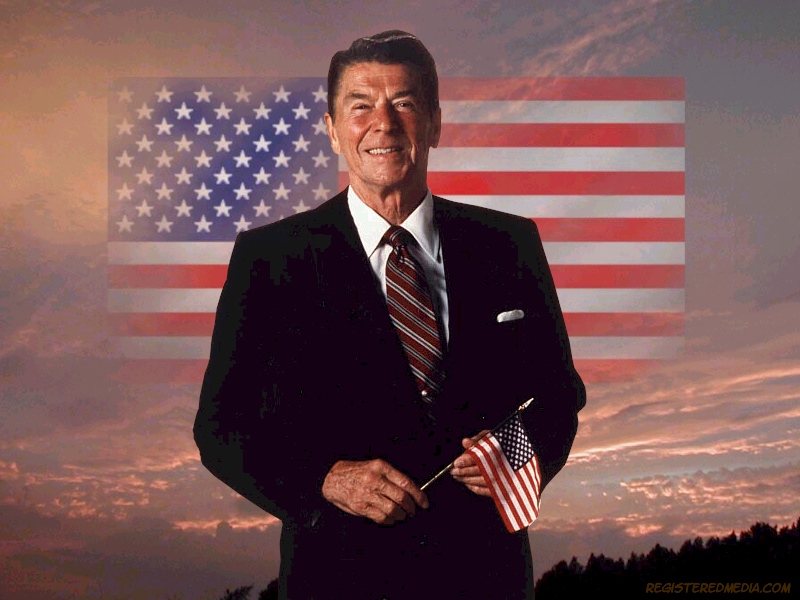
Reagan at 100 -- Super Bowl XLV Tribute Commercial

Watch President Reagan's Centennial Celebration Events Live!

Both tonight at tomorrow, there are a number of events surrounding President Reagan's 100th birthday that can be watched online.

Saturday, February 5, 2011 -- 7:00 p.m.-9:00 p.m.
The Reagan Foundation will stream live A Concert for America -- A Tribute to Ronald Reagan.  The concert is comprised of live music and in-person and video tributes from world leaders and prominent individuals whose lives were impacted by the legacy of President Reagan.  The evening's lineup includes The Beach Boys, Lonestar, Lee Greenwood, Fred Thompson, Jerry West, and video tributes from George H.W. Bush and George W. Bush.

Sunday, February 6, 2011 -- 10:00 a.m.-12:30 p.m.
The Reagan Foundation will stream live President Reagan's official birthday celebration.  The program includes a 21-gun salute, a F-18 flyover, keynote remarks by Secretary James Baker and the official laying of the presidential wreath on President Reagan's memorial site.

Click here to watch these events....

Feulner on Reagan at 100

It's been more than six years since our nation bid farewell to Ronald Reagan, born 100 years ago this month. Yet it seems at times as though he never left.

Consider how Reagan's name surfaced repeatedly after the most recent State of the Union address as pundits - both liberal and conservative - weighed the speech's effectiveness. His Photoshopped image is on the cover of Time, his arm draped around President Obama.

"If Obama has bounced back from the drubbing his party took at the polls last November," Richard Norton Smith writes in the magazine, "it is in no small measure because he has been acting positively Reaganesque as of late."

Acting, perhaps, but not governing. It's worth reminding ourselves as we mark the centennial of Reagan's birth what he accomplished - and how.

It's important to do this in part because much of what passes for praise of Reagan is veiled criticism. Reagan is hailed, for example, as a great communicator. And with good reason: Few politicians could match his rhetorical skill and his ability to articulate great themes that resonated with the American people.

But that's where many on the left stop. What they really seek to emulate is not his policies or his agenda. They hope that if they study his methods, a little of his "magic" will rub off on the liberal policies that have proved such a hard sell over the past two years. Dress the liberal agenda in Reaganesque terms, and the electorate is yours, right?

What condescending nonsense. It wasn't just Reagan's ability to communicate that endeared him to millions of Americans. It was the fact that he was articulating their most deeply cherished beliefs. It went well beyond the optimistic outlook - which, although welcome, is something any president can attempt. It was because he spoke in direct terms that avoided the usual buzzword approach we get from Washington.

He used that approach to say what many Americans thought: Taxes are too high - let's cut them. Inflation is too high - let's tame it. The Cold War can be won, not managed, and the world made safer for everybody - let's do it.

The fable of the left (the hard left, anyway - many others are coming around) is that this was all smoke and mirrors. But the facts tell a different story. Starting from the "stagflation" mess his predecessor handed him, Reagan created a genuine economic miracle. After a three-stage tax cut and a reduction in government growth, our economy began to expand - by 31 percent from 1983 to 1989 in real terms. Americans of every class - rich, middle-class and poor - saw their wealth increase.

It was our nation's longest peacetime expansion in a long and prosperous history. By decade's end, we had added the economic equivalent of a new Germany to our gross national product. Inflation was cut by two-thirds, interest rates by half. Unemployment dropped to the lowest level in 15 years.

Even before the end of his first term, the signs of distinct progress were unmistakable. Small wonder that Reagan's famous "Morning in America" campaign resonated with so many voters, leading to a landslide re-election in 1984. Starting from the "stagflation" mess his predecessor handed him, Reagan created a genuine economic miracle.

People loved him for it. That's why so many politicians, both Republicans and Democrats, seek to portray themselves as latter-day Reagans. To decide whether they deserve this mantle, however, consider this quote from his farewell address:

" 'We the people' tell the government what to do; it doesn't tell us. 'We the people' are the driver, the government is the car. And we decide where it should go, and by what route, and how fast."

Only a politician who agrees with this - and governs accordingly - can be considered Reagan's true heir.

Ed Feulner is president of the Heritage Foundation (heritage.org).

Friday, February 4, 2011

The Classical Virtues of Ronald Reagan

From our good friend, Dr. Lee Edwards at the Heritage Foundation, who wrote this piece on Heritage.org earlier this week...

The best political leaders embody the classical virtues of courage, prudence, justice, and wisdom. President Ronald Reagan had all these qualities and in abundance.

Courage

When he was shot on March 30, 1981, President Reagan seemed to spend most of his time reassuring everyone that he was not seriously hurt, although the bullet had stopped only one inch from his heart and the doctors were very concerned about his substantial blood loss. As he was wheeled into the operating room, he noted the long faces of his three top aides—James Baker, Ed Meese, and Michael Deaver—standing in the hall and asked, “Who’s minding the store?” When a distraught Nancy Reagan made her way to him, he lightly said, “Honey, I forgot to duck.”

Both conservative and liberal commentators lauded Reagan. “The president’s imperishable example of grace under pressure,” wrote George Will, “gave the nation a tonic it needed.” “Everybody knows,” wrote James Reston of The New York Times, “that people seldom act in the margin between life and death with such light-hearted valor as they do in the movies. Yet Ronald Reagan did.”

It also takes courage to challenge an enemy like the Soviet Union when the stakes are high. There was vehement Soviet opposition to his Strategic Defense Initiative (SDI), but the President did not budge. At the Reykjavik summit, when both sides were very close to a far-ranging agreement on nuclear weapons, Soviet leader Mikhail Gorbachev pressed hard for laboratory testing only of SDI. Reagan refused. His steadfast commitment to SDI convinced the Kremlin that it could not win, or afford, a continuing arms race and led to an end of the Cold War at the bargaining table and not on the battlefield.

Prudence

Rather than dispatching American combat troops to trouble spots, Reagan assisted pro-freedom anti-Communist forces in Afghanistan, Nicaragua, Angola, and Cambodia. National security analyst Peter Schweizer estimates that the cash-strapped Soviets spent $8 billion a year on counterinsurgency operations against U.S.-backed guerrillas. The accelerating Soviet losses in Afghanistan demoralized the Kremlin and the Red Army, hastening the collapse of the Soviet empire.

At home, Reagan practiced the politics of prudence by relying upon his “70 percent rule”: If he could get 70 percent of what he wanted in the face of opposition, he would take his chances on coming back and getting the other 30 percent later. He wanted his 25 percent tax cut to take effect immediately in 1981 but agreed to phase it in over three years because the cuts were across the board. He was that rare politician who knew when to bend a little and when to stand firm.

Justice

Although it was not politically correct, President Reagan steadfastly defended the rights of every American—from the moment of conception to that of natural death. For him the sanctity of life was not a slogan but a fundamental principle to be honored. When in 1983 he wrote “Abortion and the Conscience of the Nation” (an essay for Human Life Review later published as a book), he became the first sitting President to write a book while in the White House.

His Administration sought not only to put America’s financial house in order and rebuild the nation’s defenses but also to put America’s moral house in order by protecting the unborn and allowing God back into the classroom.

Wisdom

President Reagan had the ability to foresee what others could not. In the early 1980s, liberal intellectuals such as Arthur Schlesinger, Jr., and John K. Galbraith were lauding the economic accomplishments of the Soviet Union. At the same time, Reagan told the British Parliament that a “global campaign for freedom” would prevail over the forces of tyranny and that “the Soviet Union itself is not immune to this reality.” By the end of the decade, as he predicted, Marxism–Leninism was dumped on the ash heap of history.

In late 1981 and all of 1982, when his tax cuts had not yet kicked in and the U.S. economy still lagged, President Reagan reassured his worried aides and counseled them to stay the course. He had faith in the American people, who, if they could be “liberated from the restraints imposed on them by government,” would pull “the country out of its tailspin.” In the closing days of 1982, America began the longest peacetime economic expansion in U.S. history up to that time, creating 17 million new jobs during the Reagan years.

Ronald Reagan’s trust in the people and his love of freedom were rooted in two documents—the Declaration of Independence and the U.S. Constitution. From his very first national speech on behalf of Barry Goldwater’s presidential bid in October 1964 to his farewell address to the nation in January 1989, Reagan turned again and again to the wisdom of the Founders. Indeed, more than once, he sounded like one of them.

Reiterating the central role of the American Revolution, the President said: “Ours was the first revolution in the history of mankind that truly reversed the course of government, and with three little words, ‘We the people.’”

We tell the government what to do, he said; it doesn’t tell us. This simple and yet revolutionary idea of “We the people,” he explained, was the underlying basis for everything he had tried to do as President.

Classical Virtues

The President reassured the men and women of the “Reagan Revolution” that they had made a difference. They had made America—that “shining city on a hill”—stronger and freer and had left her in good hands.

The city never shone brighter than when it was led by Ronald Reagan, who exemplified the virtues of courage, prudence, justice, and wisdom.

Lee Edwards, Ph.D., is Distinguished Fellow in Conservative Thought in the B. Kenneth Simon Center for American Studies at The Heritage Foundation.

Planned Parenthood Busted Again!

Live Action.org has done it again! You must watch this video as two undercover operatives from Live Action catch a Planned Parenthood manager in New Jersey doing what we all know Planned Parenthood does. It is both sickening in terms of how they treat minors and promote abortion and infuriating to know that Planned Parenthood receives more than $300 million annually from U.S. taxpayers. There are some new members of the 112th Congress trying to put an end to their federal funding. Let’s hope and pray it can get accomplished!

ReaganConservatives.us is an independent site and is not affiliated with any official web sites, associations, or organizations associated with President Reagan. Any views expressed or content included on this site do not necessarily reflect the views, positions, or opinions of any of the organizations or individuals named, linked, or advertised.


Questions? Contact webmaster@ReaganConservatives.us


Copyright © 2008-2011, www.ReaganConservatives.us. All rights reserved.